
CN#7. Semafor Flagship: Reinventing global news coverage

STATUS: Consumer, weekday daily, free
NEWSLETTER TYPE: Engagement
PURPOSE: “Understand the most important news and ideas shaping the world every weekday morning in your inbox.” Target audience is "premium general interest and cross border thinkers”.
LAUNCHED: October 2022
SUBSCRIBERS: Not disclosed.
WORD COUNT: 2,049
SENT FROM: Semafor Flagship <flagship@semafor.com> A corporate email address (reader connection opportunity missed).
SUBJECT LINE
“Lula’s big, narrow victory.” The news story selected for top billing, the victory of the challenger in Brazil’s election.
DESIGN
Yellow! An emulation of the Financial Times pale pink approach, the pale yellow background is certainly different. A Times-like serif font gives a traditional look and feel, although combined with the yellow, verges on antique.
On mobile, the text comes up big and clear in portrait mode, reminding us how other newsletters are set so small. This really matters for the user experience. Pinching, tweaking and twisting in order to read negatively affects engagement.
WELCOME
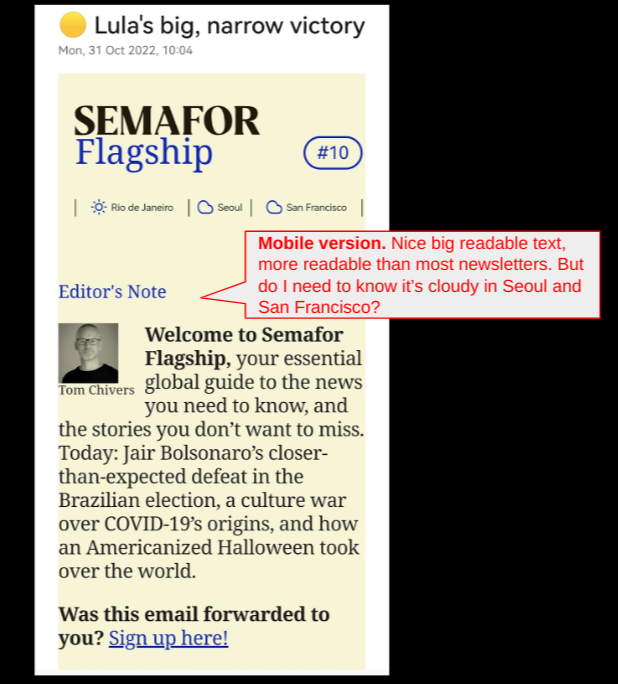
There are three token weather symbols showing that it’s either sunny or cloudy in the 3 locations where the top news is from.
There’s a to the point welcome summary from editor Tom Chivers who appears in a grey picture. Not quite as zippy or personable as a Morning Brew or 6AM City intro, instead going with gravitas for global news. That’s fine, it sets a serious tone.
EDITORIAL
There’s a world map with numbers placed in the news locations. Each number refers to one of the regular 10 news stories in the newsletter.
The 10 headlines are then handily listed below the map, with 2 additional, bonus items.
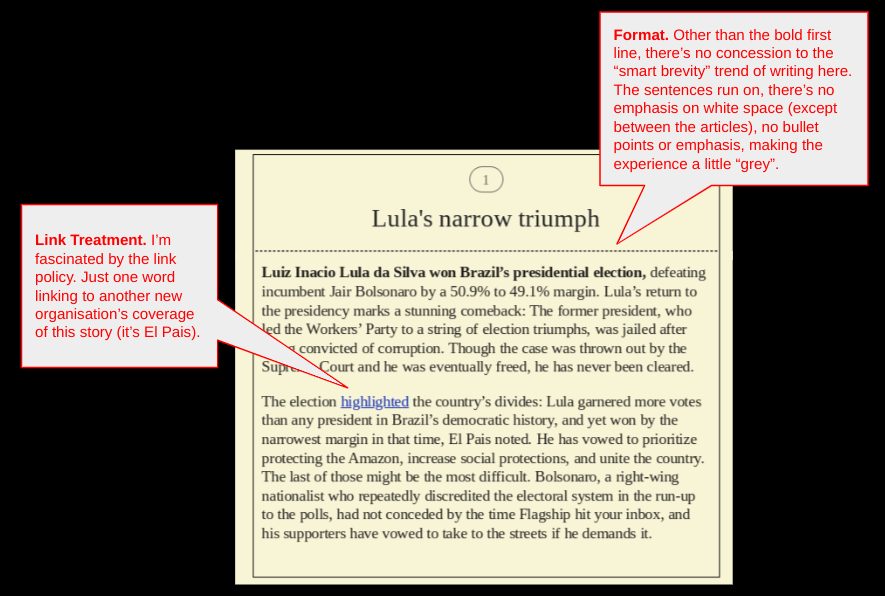
Each of the 10 news items gets 150ish words in 1 or sometimes 2 paragraphs of quite densely formatted text, with little or no white space. Every item is ruled off in a lined box, with a headline and a picture. The only concession to “ungreying” is the first line in bold.
The additional items are lighter afterthoughts. One comprises a single paragraph review for each of 3 London-based Substack newsletters featured, with links to the long read in each, and another is a frivolous piece about Halloween with a link.
Sources are rarely named (just a couple in 10 stories), and usually each story has just one link. The links follow a pretty random pattern, but the tendency is for them to be applied in the middle or bottom of the piece and to relate to a single word or phrase.
The reader doesn’t always know which websites have been used to create the summaries apart from the ones that there are mentions of links to: El Pais, thenationalnews.com, AP News, The Korea Times, Propublica, Financial Times (paywall), Nikkei Asia and the 3 individual Substack newsletters.
BUSINESS MODEL
Semafor Flagship is one of eight free newsletters offered from launch in October 2022. The business looks like a "newsletter-first" operation but this isn't stated anywhere by management. Semafor is backed with $25m in venture capital funding and has benefited from much pre-launch chat in media circles.
Apart from Flagship, the other Semafor newsletters are in vertical markets, covering for example Business, Tech, Media, and Washington politics. The collection of niches could turn out to be easier to monetise for being more specialist.
CEO Justin B Smith told The Rebooting Show that Semafor has advertising support from large corporates interested in highlighting commitment to corporate social responsibility.
Smith said Semafor would launch with an advertising model and plans later to move into subscriptions and events, so it’s fair to say that the business model is flexible and under development.
The first events have been online under the SemaforX banner and have been sponsored affairs.
MARKETING
It’s not clear how the target audience who don’t already know about Semafor will discover this new kid, and I couldn’t find anything about the newsletter marketing strategy from interviews the executives gave at launch.
Not surprisingly, the brand doesn’t show up in an “international news” search on Google, and the results show the intense competition. Just for starters, the top 10 are ABC, Sky, Euronews, CNN, Guardian, BBC, The Hindu, News York Times, Reuters and Al Jazeera.
From this it’s fair to assume that SEO will be an uphill struggle, but that still leaves plenty of scope for PR, paid advertising, word of mouth, partner promotions and referral schemes. It's not clear which of these Semafor is going to adopt.
COMMENT
One of the big ideas behind the brand appears to be to offer objective, non-partisan news as an antidote to falling trust and disconnection. But it's hard to see how Flagship is so far achieving this, as in reality there are already lots of non-partisan news organisations.
I havn’t done a story-by-story comparison but I’m guessing that nearly all those in the 10 in this issue could be found on the BBC, Bloomberg, or Reuters websites that day. All sites that would reasonably be considered to be offering objective, non-partisan news coverage.
As a concise, swift morning summary Flagship achieves the objective. If you read beginning to end or even just skim, it fulfills the promise.
The additional purpose to “understand the most important news and ideas" is a little harder to achieve. How does one define important differently from an existing global news agenda?

Drilling down into the mechanics of how Flagship is created, I find the sourcing and linking policy comment worthy, highlighting the balancing act curated newsletters must perform.
The priority seems to be to keep the reader reading, hence the limited appearance of named sources.
On the other hand there has to be some attribution to avoid accusations of plagiarism or “lifting” and the balance seems to be to make these attribution links as small and unobtrusive as possible (i.e. one or two words).
That in turn minimises the traffic to those news sites providing the original reporting. This raises a couple of questions in my mind. Is a curation model based on the reporting of others sustainable? And does it allow the curator to be clearly differentiated?
Semafor's target audience is huge and capable of sustaining a low-cost news organisation. The CEO's conviction that newsletters are the most potent and powerful way of connecting direct to new audiences is not something I'd bet against, but I'm biased.
Where exactly the business model goes is an open question and that's an acceptable approach the VC backers have bought into: We are going to do what works.
Watch out for a case study of one of the Semafor vertical newsletters in a future edition where I'll be discussing the part they might play in the revenue mix.